

EASL Liver Cancer Summit 2027 Scientific Programme
The EASL Liver Cancer Summit 2027 in Valencia will present the latest advances in liver cancer research and clinical care, highlighting innovations across prevention, diagnosis, and treatment.
Day 1 – Understanding the Foundations and Opportunities for Early Intervention
The Summit opens by exploring the changing landscape of liver cancer prevention, early detection, and translational research. Sessions will examine surveillance strategies, novel biomarkers and imaging techniques, and the immune mechanisms that precede malignant transformation. Participants will also gain insights into the latest advances in spatial analysis and innovative preclinical models that are enhancing our understanding of tumour biology and accelerating the development of future therapies.
Day 2 – Advancing Treatment and Translating Evidence into Practice
Day 2 focuses on the multidisciplinary management of primary liver cancers, from early-stage cholangiocarcinoma to the latest advances in systemic, locoregional, and perioperative therapies. Discussions will highlight the growing role of real-world evidence in shaping clinical decision-making and feature cutting-edge research presented during the oral abstract sessions, providing attendees with a comprehensive overview of emerging trends and practice-changing evidence.
Day 3 – Shaping the Future of Liver Cancer Care
The final day looks ahead to the next generation of liver cancer management, exploring precision oncology, cellular therapies, therapeutic vaccines, and liquid biopsy technologies. Sessions will delve into the role of the tumour microenvironment and microbiome, address challenging clinical scenarios and treatment-related toxicities, and tackle the hot topics that continue to influence multidisciplinary care and future directions in hepatobiliary oncology.
Programme overview
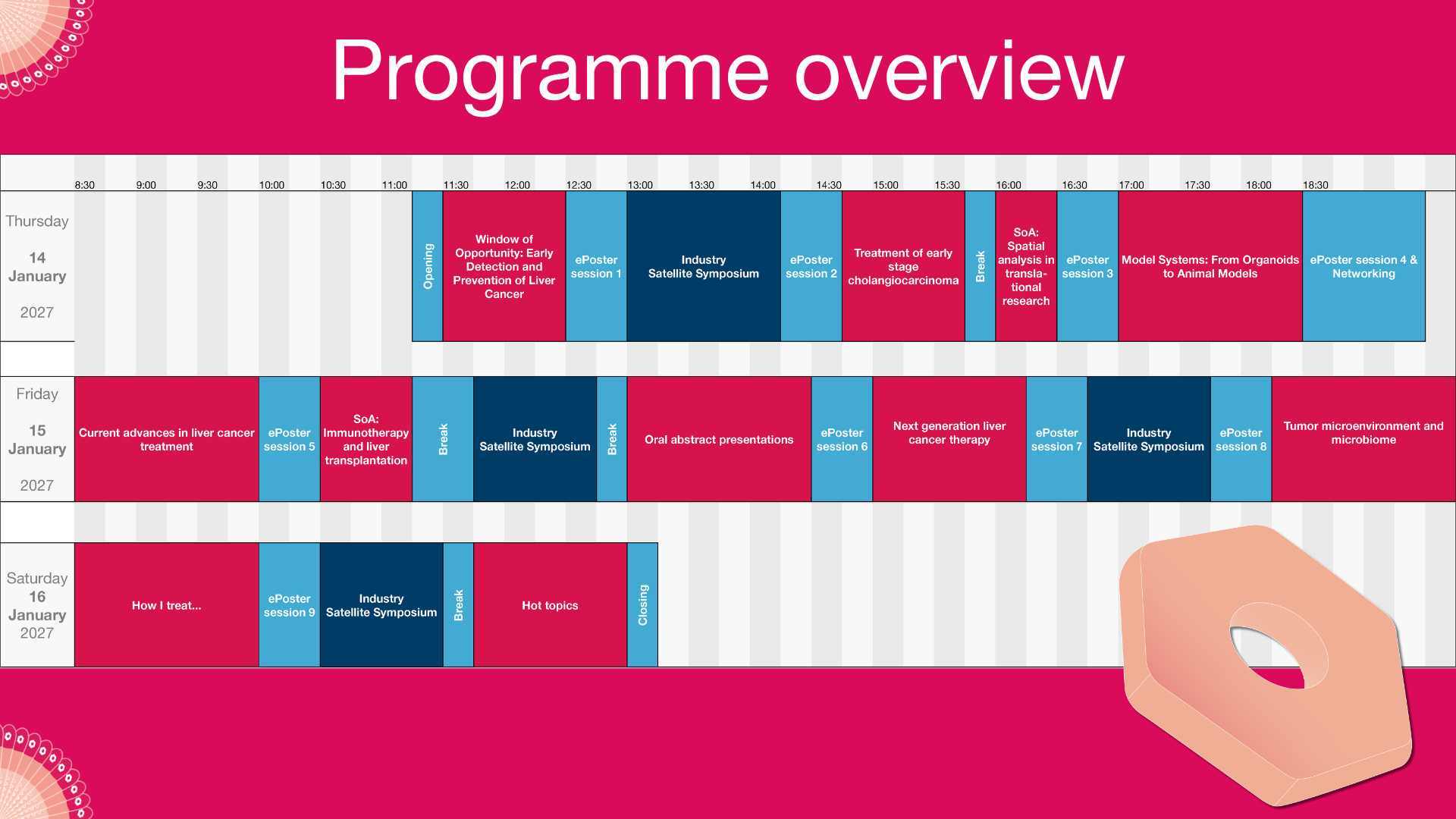
Discover the sessions
Session 1: Window of Opportunity: Early Detection and Prevention of Liver Cancer
Liver cancer's poor prognosis is largely driven by late-stage diagnosis, making early detection and prevention a critical priority. This session addresses the full spectrum of early intervention — from precancerous immune mechanisms and novel imaging strategies to surveillance gaps in the rapidly growing MASLD population — with the goal of identifying where timely action can have the greatest clinical impact.
Discuss: Gaps and future directions in HCC surveillance for patients with MASLD, and how existing strategies must evolve to meet the epidemiological reality.
Explore: How precancerous immunology can inform immune interception strategies before malignant transformation occurs.
Explain: Which current and future biomarkers and imagines techniques facilitate the most accurate diagnosis of primary liver malignancies, and critically appraise their readiness for routine clinical use.
Session 2: Treatment of early stage cholangiocarcinoma
Cholangiocarcinoma presents major surgical and oncological challenges even when detected at an early stage. This session critically examines the boundaries of curative intent, exploring how resectability criteria are defined, how systemic and locoregional therapies can be strategically combined to expand treatment options, and whether liver transplantation may offer a viable path for selected patients.
Describe: The current resectability criteria for biliary tract cancers and the factors that determine surgical candidacy.
Discuss: The rationale and evidence for combining systemic and locoregional approaches in the management of intrahepatic cholangiocarcinoma.
Explore: The expanding indications for liver transplantation in iCCA and the conditions under which it may improve outcomes.
Session 3: State-of-the-Art: Spatial analysis in translational research: Mapping the Malignancy
This lecture explores how spatial transcriptomics and tissue-based spatial analysis are transforming our understanding of the tumor microenvironment in liver malignancies.
Explore: How spatial transcriptomics maps gene expression and cellular interactions within their architectural tissue context, revealing crosstalk between malignant, immune, and stromal cell populations that conventional bulk analyses cannot capture.
Discuss: The implications of spatially resolved tumor microenvironment data for biomarker discovery and patient stratification in liver malignancies.
Describe: How spatial analysis can inform the rational design of novel therapeutic strategies by exposing the functional organization of the tumor ecosystem.
Session 4: Model Systems: From Organoids to Animal Models
Preclinical model systems are indispensable tools for dissecting the biology of liver cancer and bridging the gap between mechanistic insight and clinical translation. This session critically evaluates the current repertoire of available platforms — from patient-derived organoids and microfluidic organ-on-a-chip systems to genetically engineered mouse models and in vivo cholangiocarcinogenesis models — examining where each excels, where it falls short, and how collectively they can best recapitulate the complexity of human liver malignancy.
Describe: The translational accuracy and biological relevance of genetically engineered mouse models as well as organoid systems as models of liver cancer, and their potential to inform therapeutic development.
Discuss: Whether liver-cancer-on-a-chip technology has reached the maturity required for broader adoption in preclinical and translational research.
Recognize: How in vivo modeling of cholangiocarcinogenesis can illuminate the stepwise biological events driving malignant transformation of the biliary epithelium.
Session 5: Current advances in liver cancer treatment
This session will highlight recent advances in the multidisciplinary management of primary liver cancers and provide a comprehensive overview of innovations spanning local, perioperative, and systemic treatment approaches for hepatocellular carcinoma (HCC) and biliary tract cancer (BTC).
Describe the evolving role of radiotherapy in the management of liver cancer.
Discuss the rationale and emerging evidence for combining locoregional and systemic therapies, as well as perioperative treatment strategies for HCC and BTC.
Explore the latest advances in systemic therapy for advanced HCC and their implications for optimizing patient outcomes.
Session 6: State-of-the-Art: Immunotherapy and liver transplantation
This state-of-the-art lecture will summarize the current evidence on immunotherapy before and after liver transplantation for hepatocellular carcinoma (HCC).
Review the current evidence on the efficacy and safety of immune checkpoint inhibitors in patients with HCC in the peri-transplant setting
Discuss patient selection, timing, and risk stratification for immunotherapy in the peri-transplant setting
Define unmet clinical needs and future research priorities
Session 7: Oral abstract presentations
This session includes a series of oral presentations covering basic, translational, and clinical research in the field of primary liver cancers. The session is designed to promote knowledge exchange, critical appraisal, and discussion around new findings.
Summarize key findings on latest basic, translational, and clinical research topics.
Critically evaluate the methodologies and implications of presented studies.
Discuss emerging trends and novel concepts introduced during the presentations.
Session 8: Next generation liver cancer therapy
This session will discuss emerging therapeutic strategies that may redefine the future of liver cancer treatment, bringing together advances in molecularly targeted treatments, immunotherapy, cellular therapies, and biomarker development.
Describe the latest advances in precision oncology for biliary tract cancer and their impact on personalized treatment.
Discuss the emerging role of therapeutic vaccines and cell therapies in the treatment of hepatocellular carcinoma.
Explore the potential role of liquid biopsy to improve diagnosis, treatment selection, and disease monitoring in liver cancer.
Session 9: Tumor microenvironment and microbiome
This session will explore the complex interactions between the tumor microenvironment, the immune system, and the gut microbiome in liver cancer. Leading experts will present emerging insights into the biological mechanisms driving therapeutic resistance and discuss novel strategies to improve outcomes for patients with liver cancer.
Describe the role of the tumor microenvironment and its therapeutic targeting in liver cancer.
Discuss the impact of the gut microbiome and molecular predictors on response to immunotherapy.
Explore the contribution of neutrophils to liver cancer progression and their potential as therapeutic targets.
Session 10: How I treat...
This session will provide expert perspectives on the management of challenging and uncommon clinical scenarios in liver cancer. Speakers will address both rare tumor subtypes and the management of important comorbidities and treatment-related toxicities.
Describe current approaches to the management of rare hepatobiliary malignancies, including ampullary carcinoma, combined hepatocellular–cholangiocarcinoma, and fibrolamellar carcinoma.
Discuss strategies for optimizing the management of underlying liver conditions, including viral hepatitis and portal hypertension, in patients with liver cancer.
Explore best practices for the recognition and management of severe immune-related adverse events associated with cancer immunotherapy.
Session 11: Hot topics
This session will address timely and evolving topics in liver cancer that continue to shape clinical practice and multidisciplinary decision-making.
Debate the strengths, limitations, and clinical implications of different staging systems for hepatocellular carcinoma.
Discuss strategies for optimizing liver cancer management in resource-sensitive settings and for selecting appropriate patients for radioembolization.
Explore recent evidence and challenges of immunotherapy in the context of liver transplantation.