

EASL Steatotic Liver Disease Summit 2027 Scientific Programme
The EASL Steatotic Liver Disease Summit 2027 comprises two parts:
Part 1: EASL MASH Innovation and Implementation Roadmap (10–11 February)
A dedicated stakeholder initiative bringing together clinicians, healthcare professionals, researchers, regulators, payers, policymakers, industry representatives, and patient advocates to identify priority implementation challenges and build consensus on translating innovation into equitable patient access across European healthcare systems.
Part 2: Main Steatotic Liver Disease Summit Programme (11–13 February)
Ten thematic sessions and three State-of-the-Art lectures, deliberately threaded so that each clinical question is followed by the biological mechanisms behind it. A best-abstract session and eight ePoster sessions showcase emerging work across the field.
Programme overview
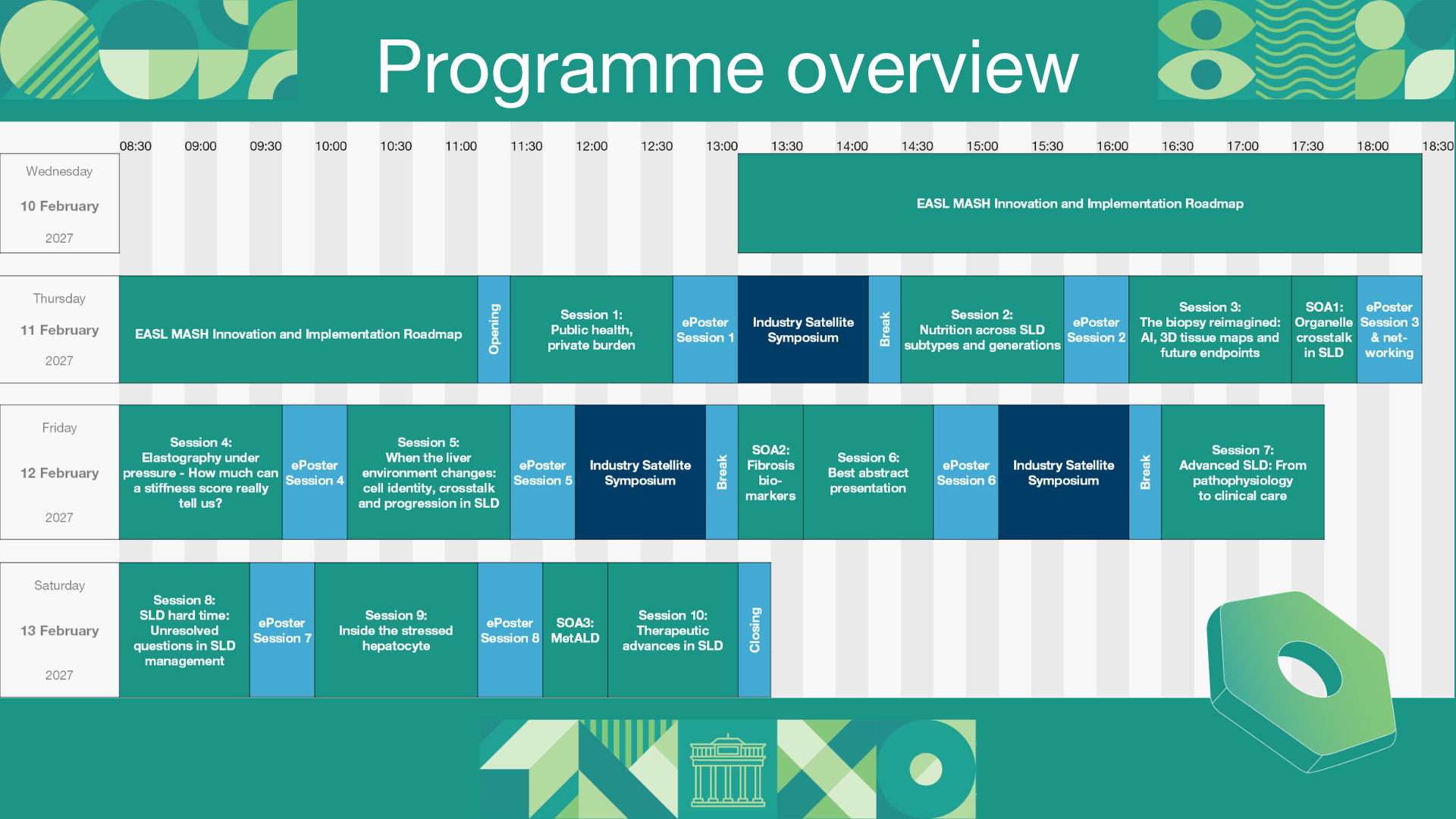
Discover the sessions
Session 1 — Public health, private burden: Policy, stigma and the patient voice
The Summit opens on the gap between recognition and change. Three years after the nomenclature shift and against the backdrop of a WHO resolution, this session asks whether renaming a disease and passing a resolution have actually moved health systems, reduced stigma, or reached the patient. With the diabetologist’s and the obesity specialist’s perspectives, it confronts the hidden, cross-specialty burden of SLD and the uncomfortable possibility that policy progress and patient experience have diverged.
Session 2 — Nutrition across SLD subtypes and generations
Nutrition is reframed here as therapy rather than lifestyle advice, and across the life course. Talks move from nutritional care in alcohol use disorder — beyond abstinence, to the adolescent exposome of alcohol, ultra-processed food and inactivity, and finally to the MASLD “calorie myth,” interrogating whether dietary composition matters more than quantity. The through-line is that the same nutritional levers act differently across SLD subtypes and generations.
Session 3 — The biopsy reimagined: AI, 3D tissue maps and future endpoints
This session puts the liver biopsy on trial. It asks whether AI can read histology better than expert pathologists, what three-dimensional tissue mapping adds beyond the two-dimensional section, and how trial endpoints should be redefined in a post-biopsy era.
State-of-the-Art 1 — Organelle crosstalk in SLD
A deep-dive lecture on how intracellular spatial organisation and organelle communication shape liver-cell function in steatosis, setting a mechanistic foundation for the days that follow.
Session 4 — Elastography under pressure: How much can a stiffness score really tell us?
A field guide to which elastography tools actually predict outcomes, followed by the harder question of whether a measured change in stiffness reflects a true change in disease — the core of treatment-response monitoring. The session then crosses from measurement to mechanism, examining how matrix stiffness itself reshapes liver-cell behaviour. It is a rare and welcome attempt to connect the kPa on the report to the biology generating it, rather than treating the number as an oracle.
Session 5 — When the liver environment changes: cell identity, crosstalk and progression
Here the focus shifts to the microenvironment as a driver of disease. Spatial macrophage niches in MASH, mitochondrial crosstalk linking the steatotic liver to the stressed heart, and the reprogramming of cell fate from repair toward fibrosis together make the case that progression is dictated as much by tissue context as by the hepatocyte in isolation.
State-of-the-Art 2 — Fibrosis biomarkers without a gold standard
A lecture on the pragmatic art of combining diagnostic tools to stage fibrosis in the absence of a true reference standard — a methodological problem the rest of the programme keeps circling back to.
Session 6 — Best abstract presentations
A platform showcasing four top-ranked submitted abstracts, giving primetime to emerging and unpublished work.
Session 7 — Advanced SLD: From pathophysiology to clinical care
This session addresses the sharp end of the disease. It opens with the sinusoidal, beyond-collagen basis of portal hypertension in advanced SLD, moves to the prevention of decompensation and the increasingly important concept of re-compensation, and closes on whether bariatric surgery is friend or foe in advanced disease. The result is a continuous line from sinusoidal pathophysiology to concrete decisions in the cirrhosis clinic.
Session 8 — SLD hard time: Unresolved questions in management
A deliberately uncomfortable session on the methodology of MASH trials. It tackles the ethics of placebo arms now that effective therapy exists, the silent crisis of screen failure that quietly undermines trial feasibility, and the recognition and management of non-responders to anti-MASH therapy. This is where the field’s rigour — or lack of it — is laid bare.
Session 9 — Inside the stressed hepatocyte: Adaptation, metabolism and cell fate
Returning to the cell, this session examines lipid overload and hepatocyte reprogramming in MASLD, the heterogeneity of hepatocyte responses under metabolic stress, and what happens in alcohol-related injury when adaptive stress responses fail. The emphasis is that not all hepatocytes respond alike — and that failure of adaptation, not merely the insult, determines fate.
State-of-the-Art 3 — MetALD: Can we treat a disease we cannot yet define?
A lecture on the conceptual and clinical no-man’s-land between metabolic and alcohol-related disease, and the awkwardness of designing therapy for an entity still searching for a stable definition.
Session 10 — Therapeutic advances in SLD: Current standards and future directions
The Summit closes on treatment: updates on approved MASH-targeted therapy under the EASD–EASO–EASL guidance, the current and emerging options in ALD, and the mechanisms and targets shaping the next generation of SLD therapeutics. It closes the loop opened on day one — translating the policy urgency and mechanistic insight of the preceding sessions into what we can, and soon may, actually prescribe.