
About the EASL Global Liver Advocacy Network (GLAN)
The EASL Global Liver Advocacy Network (GLAN) is a worldwide initiative launched at EASL Congress 2025 to unite advocates, healthcare professionals, and organisations in the fight against liver disease. GLAN provides a collaborative platform for knowledge-sharing, cross-border partnerships, and policy advocacy to advance liver health and ensure that liver disease is recognised and prioritised globally.
At its core, GLAN aims to:
- Drive policy change: we work to put liver health higher on national and global agendas by promoting early detection, prevention, and treatment of liver diseases, as well as advocating for increased research funding and public education campaigns.
- Facilitate cross‑border collaborations: we connect stakeholders across countries and continents to share expertise and develop joint solutions to common challenges, such as reducing stigma and improving access to liver disease screening and care.
- Share success stories and best practices: we host conferences, webinars, and forums where impactful advocacy initiatives can be showcased, discussed, and replicated across different regions and health systems.
GLAN Programme of Work (2026-2028)
Following the launch of GLAN and subsequent online consultations with members, the network agreed on a priority proposal to focus on liver health education in children and adolescents. GLAN is now working to embed liver health education into national and regional school curricula, recognising this as a strategic investment in long‑term population health and liver disease prevention. By integrating liver health into school‑based learning, GLAN aims to raise awareness, change behaviors, and reduce the future burden of liver disease.
Scope and focus of liver health education:
For curriculum purposes, “liver health” is defined in an accessible and prevention-oriented way that speaks to non-specialist audiences. School‑based liver health education will focus on:
- The basic physiological functions of the liver and its central role in metabolic health.
- How unhealthy diets, excess energy intake, and physical inactivity can lead to liver fat accumulation and metabolic dysfunction.
- The protective benefits of regular physical activity for maintaining liver and overall metabolic health.
- Age‑appropriate education on alcohol‑related harm and its impact on long‑term disease risk.
- Prevention of viral hepatitis through vaccination, public health measures, and the importance of testing.
Through this program, GLAN supports national and regional education partners in the integration of evidence‑based, age‑appropriate materials for children and adolescents.
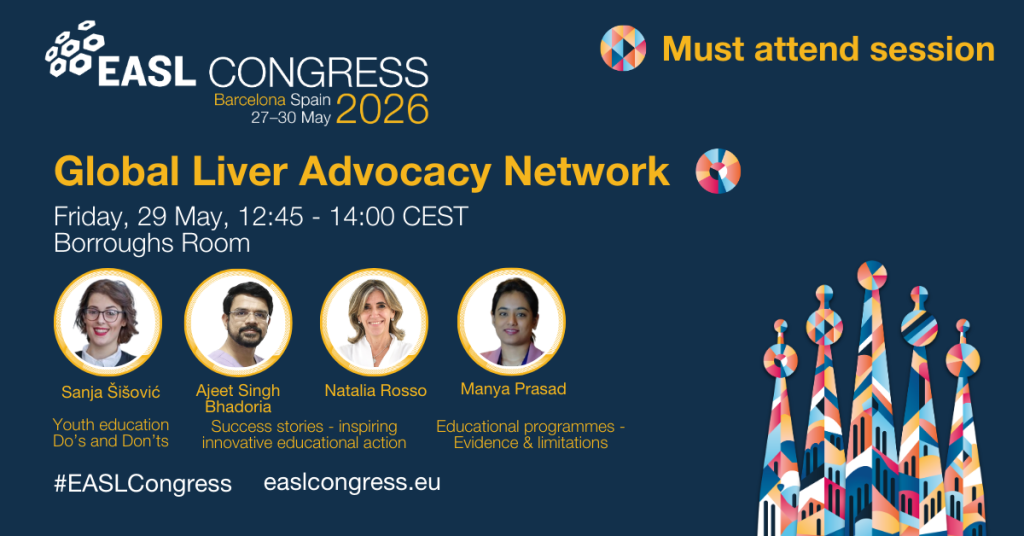
2026 – New Position Statement: “Integrating Liver Health Education into Primary and Secondary School Curricula as a Component of National Prevention Strategies”
The GLAN is currently developing and promoting a position statement calling for liver health education to be incorporated into primary and secondary school curricula. The initiative supports school-based, age-appropriate education on healthy diet, physical activity, alcohol harm prevention, and viral hepatitis prevention as part of broader national strategies to improve health literacy, reduce stigma, and prevent liver disease across the life course at a global level.
2027/2028 – Development of Liver Health Lesson Plans
In the next couple of years, EASL, the GLAN members, and our educational partners will co-create two liver health lesson plans, one for children aged 10-11 and another for adolescents aged 14-15. These lesson plans will be downloadable and ready to use for teachers and schools who wish to implement them.
More details to follow.
Join the GLAN
We would like to invite passionate advocates, health professionals, and health and advocacy organisations committed to advancing liver health to apply to join the EASL Global Liver Advocacy Network. Launching at EASL Congress 2025, this initiative will unite a global community dedicated to raising awareness, influencing policy, and driving impactful change in the fight against liver disease. By joining this network, you will have the opportunity to collaborate with like-minded professionals, share best practices, and strengthen advocacy efforts worldwide.
If you are eager to be part of this new initiative, we encourage you to apply. Below, you will find details on eligibility, objectives, and the application process.
Why join the EASL Global Liver Advocacy Network?
- Be part of a unified voice that drives global action on liver health.
- Gain access to cutting-edge resources, training, and collaboration opportunities.
- Amplify your impact through partnerships with a global community of advocates.
- Shape the future of liver health by contributing your ideas, experience, and expertise.
Who can join the EASL Global Liver Advocacy Network?
- Individuals working in liver-related medical fields.
- Members should have a shared interest in advocating for improved public health policies.
- Members should be interested in participating in EASL’s meetings and events to learn from and share advocacy success stories.
Application process
- Candidates are to provide a completed application file (details below) by email to Irene Mosqueira at EASL office – irene.mosqueira@easloffice.eu
- The file will then be submitted for review during the next scheduled Policy, Public Health, and Advocacy Committee meeting (monthly review).
- Answer to be provided to the candidate by email thereafter.
Application file criteria
- Submit a cover letter explaining your interest in becoming a member of the Global Liver Advocacy Network. Include information describing previous work and activities/initiatives that demonstrate an alignment with the network.
- Submit your CV
- Provide any disclosures/conflicts of interest and sources of funding from the private sector by using this form: https://easl.eu/wp-content/uploads/2025/02/EASL-Disclosure-Form-1.pdf
Send your applications to irene.mosqueira@easloffice.eu